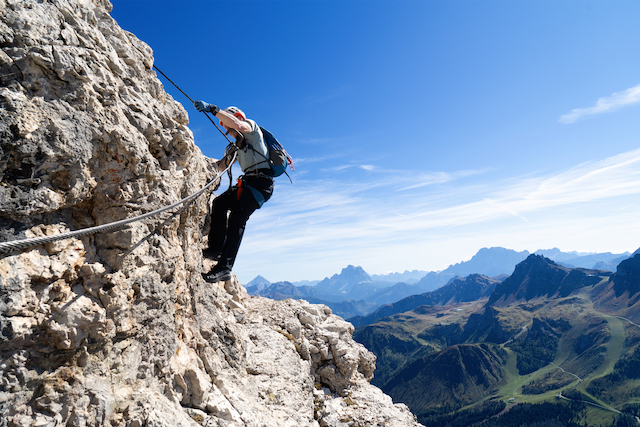
Via Ferrata of the Dolomites
I've brought together an index of about 100 via Ferrata routes in the Dolomites, not because you can't find these elsewhere, but simply in frustration at not being able to consistently get GPX files and sort routes by grade or area (which is really handy when the weather turns or your chosen route is too busy).
Enjoy!
Grades
There is no universally accepted grading system so I’ve used two.
IMPORTANT
The Grades referred to here are also described as in fine, dry weather. So a B might be straightforward on a fine day in September, but if a storm comes in it’ll be more challenging and later in the season if there is significant snow it's quite another thing entirely. Hence it’s worth considering both grading systems when you choose your route.
Schall
This Autumn scale simply uses A - F
A - Easy
Flat to steep, mostly rocky, exposed passages possible. Steady footing and a head for heights are recommended.
B - Straightforward
Steep terrain, but perhaps some more exposed sections.
C - Difficult
Steep to very steep rocky terrain, and very often exposed passages with small footholds and longer or overhanging ladders.
D - Challenging
Vertical, often overhanging, and highly exposed. Requires significant strength, for longer vertical or overhanging climbing sections. Not suitable for beginners.
E - Extremely Hard
Mostly vertical to overhanging, exposed throughout, very small steps or slab climbing. extremely demanding on physical fitness.
F - Extreme
Only for experienced climbers. Often overhanging, or exposed, good climbing technique and significant strength is essential.
In my experience, by the time you do E or F you might as well just go rock climbing.
Smith Fetcher
The Smith Flether grades come in two halves: Technical Difficulty and the level of Committment.
Technical Difficulty
1: Very easy; mostly walking, cable for handrail.
2: Straightforward; protected path with some steep sections.
3: Difficult; not for novices, requires confidence, some sustained steep sections.
4: Demanding; steep, requiring upper body strength and mountaineering experience.
5: Very demanding; steep, overhanging, or requires good technical climbing ability.
Commitment
A (Low) Short, low exposure, easy access & retreat.
B (Moderate) Longer, more exposure, some remote sections.
C (High Commitment) Long, remote, high exposure, limited options for retreat.
So for example, Via Ferrata Cesare Piazzetta is a 5C: Demanding and hard to retreat if you get into difficulty.
Dangers
Mountains can be dangerous, particululary for the inexperienced for unprepared. In just one month of the 2025 season there were over 80 fatalities (not accidents, fatalities). The majority of these were ill-equiped or inexperienced people, sometimes hikers straying onto via ferrata routes in error or ignoring danger signs.
Be careful out there, mountains are unforgiving. Don't become a statistic.
Respect them.
Dolomites are famous for sudden weather changes. Thunderstorms often build late afternoon, which can turn a ferrata into a very dangerous place - you’re on steel cables and ladders high on a mountain! And high winds can turn any routes into a challenge (see gear list).
Snow or ice, particularly early in the season. make for an entirely different experience (see note on Grades)
Other people can be a real hazard; popular routes can get really crowded in July & August, with the risk of impatience and rock fall.
Do I need a guide?
If this is you're first time, I highly recommend a guide, even if you're an experienced mountaineer or climber. Guides know the area, can assess your abilities and you can always learn something new. Always. Despite decades in the mountains, we hired a guide for a couple of days, had a great time, learnt some skills and then headed out on our own.
Great way to go.
Recommended Guides
- Ulrich Schwingshackl (I've used Uli)
- WhatsApp +39 348 558 8577
- klettern-dolomiten.com/
- Florian Grossrubatscher
- WhatsApp +39 347 626 11 06
- Email info@dolomagic.it
- dolomagic.it
- Thomas Zelger
- WhatsApp +39 333 4870547
- Email info@tomzelger.com
- tomzelger.com/
What to take
- Harness
- Helmet
- Good footwear
- Via Ferrata set
- Gloves
- Windproof jacket
- Day pack: 20L is ideal
- Extra sling and carabiners (good for resting)
- Short length of rope (20m - 25mm) - useful if one of your party gets into difficulty and/or always useful if you need to retreat.
- Plenty of water
- Lunch & snacks
- Emergency extras (assume you could spend the night outside on a ledge somewhere or be late getting off after an epic):
- Extra food
- A first aid kit
- Head torch
- PLB