Via Ferrata Mario Zandonella
Description
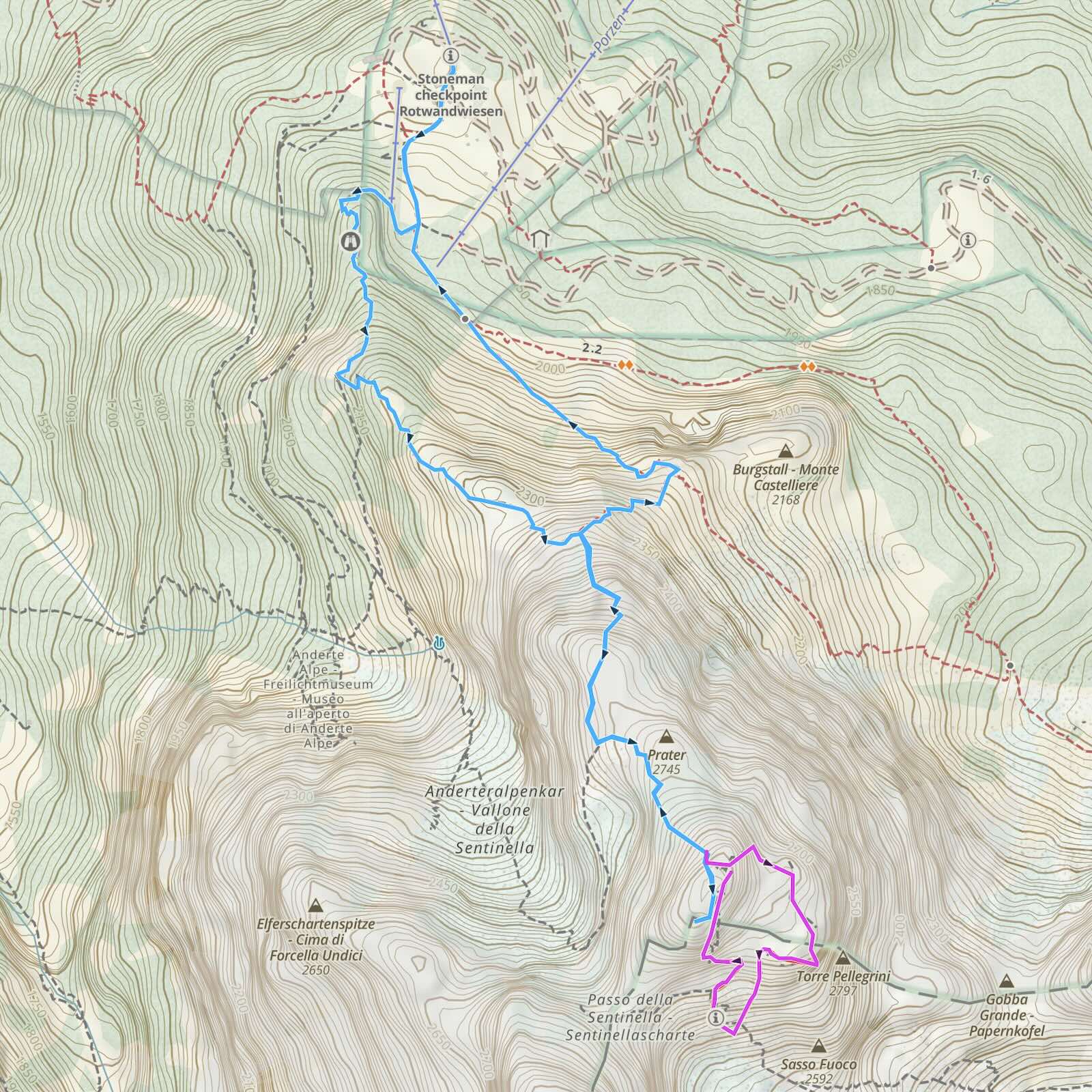
This STARTS from the summit of Croda Rossa via the same ridge as the Ferrata Croda Rossa, also used for the descent. The Mario Zandonella ferrata (marked in pink below) consists of two sections: the first is moderately difficult, while the second, as part of the Croda Rossa route, is considered more challenging.
This is a LONG day, since you have to do all of ferrata Croda Rossa (marked in blue) just to reach the start.
Access & starting point
Via Val Pusteria to Sesto/Candido, then to Sesto-Moso, where the Croda Rossa cable car provides access to the upper station.
Approach
From the upper station (1914 m), follow trail no. 100 across the Prati di Croda Rossa, then up to Coston di Croda Rossa. Follow signs for "Ferrata Croda Rossa" all the way to the top.
Route
From the summit of Croda Rossa (2960 m), descend slightly to a fork where the Zandonella trail branches off (marked red and white). Head south-east, down a scree slope (steel cable), then through exposed terrain to a gully reaching 2743 m. Continue to a steep descent to ~2780 m, where a traverse along the rock wall brings you to a cave (used during WWI) with a "ferrata" sign. Climb with the aid of a steel cable and short ladders, crossing an old position and passing through a narrow gap to reach the summit ridge of Croda Rossa.
Technical Details
A spectacular and long route, demanding and impressive, following old WWI military trails. The views and sheer drop-offs are stunning. The Zandonella ferrata is well-protected with new steel cables. Beware of thunder storms and poor weather.
Descent
Same options as for Ferrata Croda Rossa, or descend to the scree basin below Wurzbach summit (before the ladder). From there, instead of descending via Coston di Croda Rossa, turn right and follow a narrow rock gap and trail 15B (Castelliere/Burgstall) back to the starting point.
Even with an early start this is a very long day; the cable car down closes at 17:00 and if you miss that its another 90 minutes back to the car park.
Gallery
